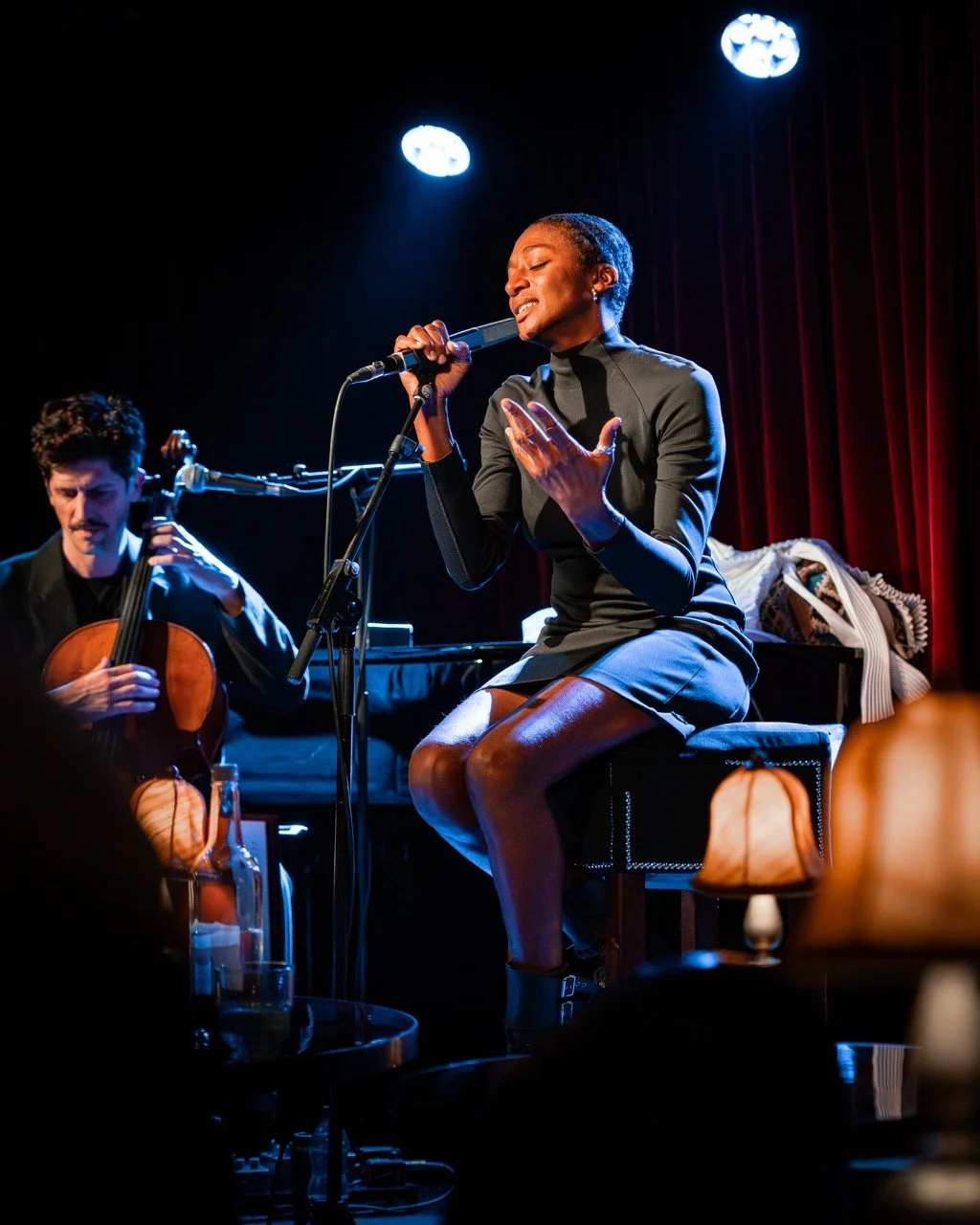
Following her sold out shows at the legendary Ronnie Scott's, we caught up with the singer-songwriter to discuss her latest album, Sunshine Music, her Caribbean heritage, musical influences and the importance of connection, community and creativity.
Congratulations on your sold-out shows at Ronnie Scott's! What is it like being able to return to such an iconic jazz venue, and how did you feel about the audience's response to your music?
Thank you! I had such a wonderful moment there that day. Memorable. I’m not used to the double show, jazz way, but it was good learning and discipline. The audience were great. They laughed, cried and collectively made music with the percussion instruments I handed out. A very interactive experience on all sides. I have been attending that club since I was 11 years old. It was for a Disney audition. In my late teens/ early 20’s, I would go there to partake and sing at a Tap Jam night. Also I was part of the W3 jam band when it first started, which is now a regular slot at Ronnie’s, so it really did feel like a homecoming.
Your latest album, Sunshine Music, draws inspiration from your time spent in Barbados, Grenada and Jamaica. How did those experiences deepen your connection to your Caribbean heritage, and how did they influence the direction of the album?
It really was life changing. I had never lived in a black majority country before. It was around George Floyd time, so felt even more important to restore my own Afro identity. Simple things like going to a swimming pool, yoga class and it being all black people. It would make me cry. I have often, if not always been the only person of colour in those spaces and didn’t really take much notice until I saw the opposite. Also not just knowing but feeling the cultural connections and impact that Caribbean culture has had on the world. Whether it be through reggaeton, rap/ hip hop. Those genres of music would not exist without the Caribbean, mostly Jamaican influence. Acknowledging and embracing that Malcolm X’s mum was a Grenadian and Dave Chapelle too. Many people don’t know that, black Americans included. We just get brushed with a monolithic brush of blackness. So easy. Too easy.
I come from a West Indian background too, and calypso is one of my favourite genres of music. It holds a special place in my heart, so I was particularly excited to hear its influence throughout Sunshine Music. What is your personal relationship with calypso, and what inspired you to bring those sounds into your music?
Well, my dad played bass in many calypso/ soca/ reggae bands, so it has always been present in my home. It’s the soundtrack to any gathering of my family. I love the story telling aspects, the cheeky innuendos, double entendres and the rhythms that can not, not be danced to. My little sister loves to blast the latest soca hits in the car very loud and proud. The kitchen ladies, myself included, making roti, fish cakes, bakes, curry goat always need our island music to dance to, to add that extra spice to the food. Also, a big impact and inspiration has been Claudia Jones. The amazing woman who started the first carnival in London and also the first West Indian gazette in the UK, amongst many other unknown achievements for the progress of our people. I’ve been writing a script about her life and that is really what took me to the Caribbean in 2021. Research. My co-writer and I rented villas in Grenada and Jamaica, did our week of quarantine and turned it into VERY intense, “you can’t leave, so get the shit done”, writing sessions. It also lead me into the home of the Mighty Sparrow in Queens, New York, on a rainy October day. He sadly has recently passed. I wanted to have him sing a calypso song I had written about Claudia. He actually performed at one of her carnivals. Unfortunately we never got to do it, but I did get to have many wonderful conversation with this legend and have him serenade me via video call many times. So sweet was the Birdie. I did also use an interpolation of his song “Slave” on my Sunshine Music album, on the song “Tief”, which is about reparation. A kind of continuation, part deux of Sparrow’s original song.
One of the things I loved most about your recent performance at Ronnie Scott's was how interactive it was, from handing out instruments to the audience to walking around the room singing. You have an almost magical voice that echoes like a lullaby. How important is that connection with your audience, and what do you enjoy most about performing in such an intimate setting?
It’s everything to me. I need to smell the audience. I’m a big stand up comedy fan and kind of treat my shows more with that mindset. I’m doing my best take of “crowd work”. It’s conversational, personal and up close. How life should be.
Your music has such a timeless quality, blending influences from jazz, soul, bossa nova and classic songwriting. Growing up, which artists or musical traditions had the biggest influence on your sound, and are there any unexpected influences that listeners might be surprised to hear about?
Oh gosh, where do I start? I went to theatre school, so I’d be singing Sondheim and dancing to Vivaldi at school, go home and hear Peter Tosh and then be sat in the art room during break time, being a rebel, listening to Rage Against the Machines and Skunk Anansie. I am very open when it comes to music. It’s a study, a constant learning for me. I try not to close myself off. I love people playing their musical preferences to me, as I don’t really have my own “favorites”. If I had to chose a preference, it would be... silence.
I know you've collaborated with some incredible artists over the years, including Mary J. Blige, Iggy Pop and Jon Batiste, but I'm also curious about the musicians you perform with. At Ronnie Scott's, you were joined by cellist Valentin Mussou and guitarist Thomas Naïm. Do you personally select the musicians who accompany you on stage, and what do you look for when building that musical connection?
Ooo I like this question. I often say to my musicians, “I can’t hear you. That’s great!” Meaning, If I hear you playing, then it’s wrong. I want to feel the music. The moment, I come out of that zone, the collective zone, means that they have started to overplay or maybe played a wrong note, which of course happens. Music is for sharing. Leave your ego at the door. Also, a love of food is important. Aside of music, it’s the next most important thing in my life. I also like to do a bit of circle singing, improvisation with any new musician I work with, so voice, body only. No instruments. Something I learnt from Bobby McFerrin. He used to do these amazing workshops. It’s a great ice breaker and instant way for me to see someone’s true personality, because we are all bare and exposed to the infinite nature of musical creation. Can you play like a child? Very important.
That actually leads me to another question, as I noticed you playing the guitar yourself during the show. When did you first learn to play, and was it something that came naturally to you?
HA HA HA HA..... I am NOT a guitarist by any stretch of the imagination. My dad actually bought me my first guitar at around age 4-5, but never really had the patience to show me how to use it. Then I had a guitar obsessed boyfriend for 5 years which helped me to grab a few chords. I used to play around London pubs and small venues solo, just me and guitar. I really had some balls doing that, but it taught me a lot. I was going to call my album around this period, “First Five Frets”, because that’s all I could play, but luckily I got a band. I do wish I had more theory embedded in my knowledge of music, but the lack of does make me do more abstract tonal music creating, like using a can of roasted garlic on my Sunshine Music album, because of the very specific sound it made and banging percussively a thick book on a table that had a singing bowl on it that would tonally ring. Very subtle, but felt.
Looking back at your debut album You & I in 2016, through ACCA and now Sunshine Music, how do you feel you've evolved as an artist, and what have you learnt about yourself along the way?
That I am die hard romantic and always will be. I do regret waiting so long between ACCA and Sunshine Music, 6 years, as the industry changed so much between this time. I also, don’t really look back too much in life generally, so can’t really see the evolution in a way to comment on it. I do know that my hair has changed.
Finally, when people listen to your music, what do you hope they feel or take away from the experience?
LOVE.
Words: Kanika Phillip