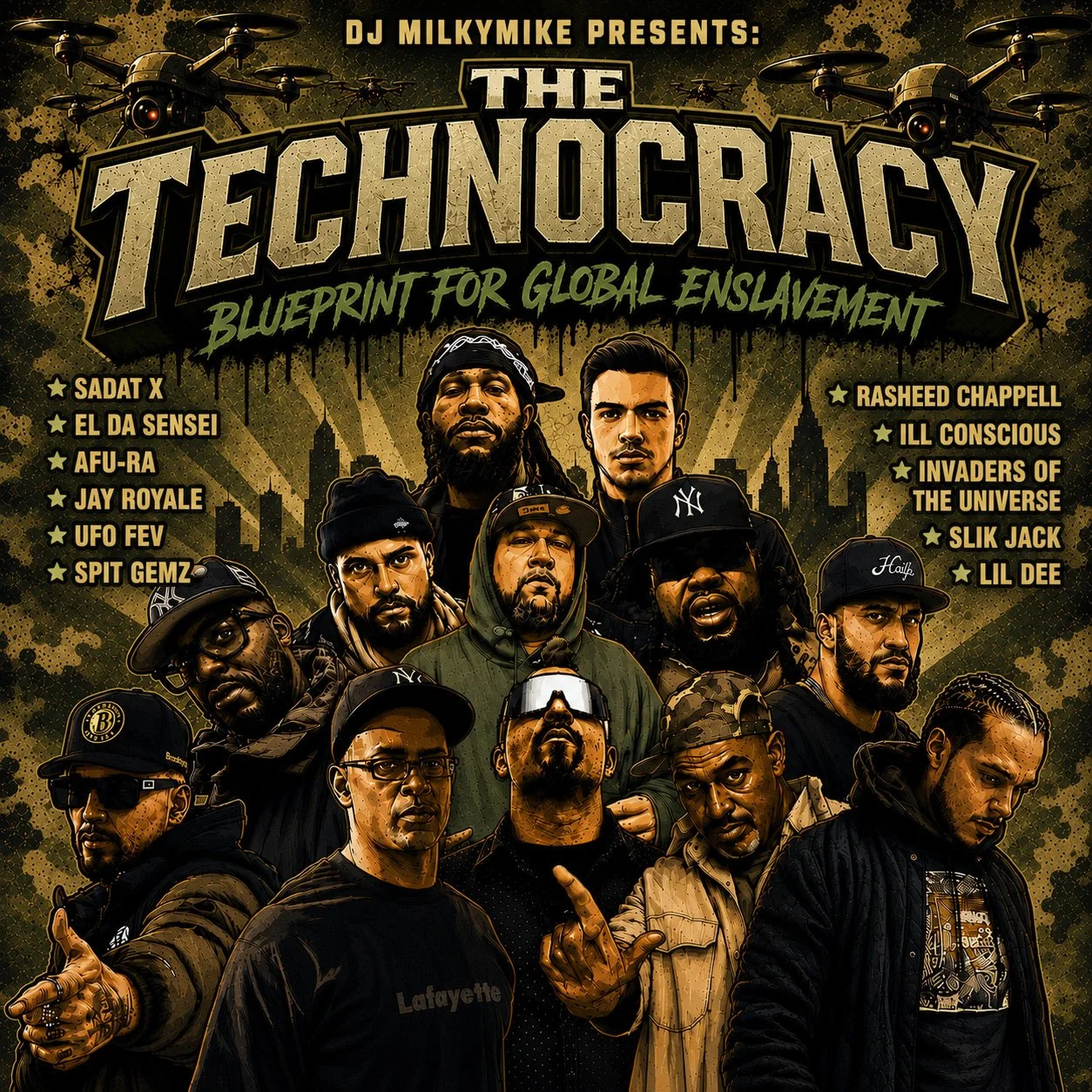
DJ MilkyMike - The Technocracy – Blueprint for Global Enslavement (Album) + 10 Questions
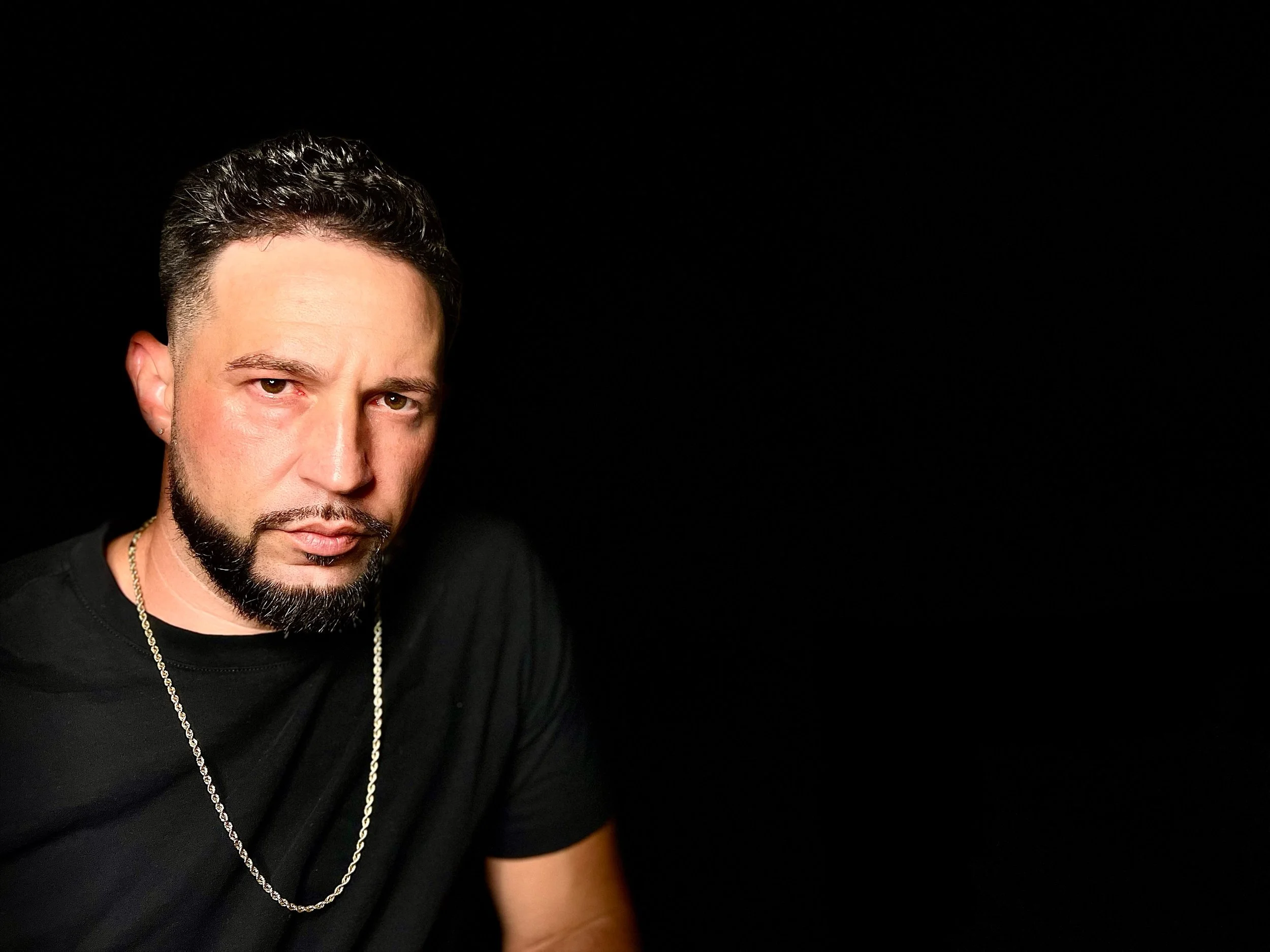
New Jersey producer, DJ and turntablist DJ MilkyMike taps into the raw foundations of East Coast hip hop on his new album, The Technocracy – Blueprint for Global Enslavement.
Released on September 14, the 12-track project pairs MilkyMike’s hard drums, dusty samples and sharp scratches with an impressive cast of underground lyricists. Produced and mixed entirely by DJ MilkyMike, with mastering handled by Gabriel “Costa” Gomes at Right Vibe Studio, the record carries the spirit of classic boom bap without simply trying to recreate the past.
Among the standouts, “Put It On” brings in Brand Nubian veteran Sadat X, while El Da Sensei steps up on “The 3rd Rail” and Afu-Ra delivers on the rugged “Iron Fist”. Elsewhere, Rasheed Chappell opens proceedings on “Brandish Steel”, with Jay Royale, Ufo Fev, Spit Gemz, Ill Conscious and more adding their own flavour across a project built around beats, bars and strong MC/producer chemistry.
Beyond the music, The Technocracy builds a dystopian world around themes of surveillance, technology, power and individual freedom. Its visual campaign brings graffiti, drones and futuristic cityscapes together with hip hop’s foundational elements, positioning creativity and independent expression against an increasingly technological society.
The Technocracy – Blueprint for Global Enslavement is out now digitally, on vinyl and CD - cop it here.
DJ MilkyMike sat down with Wordplay Magazine to answer our infamous 10 Questions:
1. So tell me, how did it all begin? What sparked your love for music?
Growing up in a house full of musicians, music was always an innate part of who I was. My father was a jazz trumpet player, and I was heavily influenced by him as well as three of my brothers, who were also musicians. Being the youngest of six, I was surrounded by music from as far back as I can remember.
When I lost my father at 14, music took on an even deeper meaning for me. There was a void that needed to be filled, and music became an outlet. With that heavy jazz influence already ingrained in me, I naturally gravitated toward hip hop culture and the music at a young age.
Growing up in a semi-rural part of New Jersey, though, hip hop wasn’t as accessible as it was in the city, you had to seek it out.
A few guys in my high school crew were DJs, and I got my first set of turntables at 15. By 16, my boys and I were making weekly trips into New York City, hitting record stores like Fat Beats, Rock & Soul, Music Factory, Tower Records and Beat Street to dig for vinyl. Three of us eventually formed a battle DJ crew called The Green Team DJs. That was really where things started becoming serious for me.
After high school, I decided to take that passion further and attended SAE (School of Audio Engineering) in New York City, where I studied music production and audio engineering. I interned and worked at several studios as an engineer while continuing to pursue my DJ career.
For roughly 15 years, I lived the DJ life, gigging four or five nights a week while simultaneously running my own business. Then, around 2020, COVID essentially shut down the nightclub world. That forced me to shift gears, but in a way it brought me full circle. I began putting more of my energy into production, taking everything I’d learned from growing up around musicians, digging for records, battling as a DJ, engineering and performing, and channeling it into making my own music.
Looking back, it feels less like I chose music and more like music was always there. The role I played just evolved over time.
2. Who are some artists that influence you and that you want to work with in the future?
My influences really come from a combination of producers, DJs and artists from the era of hip hop that shaped me. On the production side, guys like DJ Premier, Pete Rock, Large Professor, RZA, Havoc, The Alchemist and Buckwild were huge influences. I’ve always been drawn to producers who could take a sample, chop it in a completely different way and create something gritty but still musical. Coming from a jazz background, that combination of raw drums, samples and musicianship really connected with me. As a DJ and turntablist, that list goes even deeper. Growing up I was watching VHS tapes of Q-bert, A-Trak, The Executioners, 5th Platoon and a whole plethora of DMC / ITF battles. The art of digging for records, scratching and using the turntables as an instrument has always been a major part of my identity, and I try to keep some of that DNA in my production today.
As far as artists I’d like to work with, there are definitely some bucket list names, Nas, Method Man, Raekwon, Ghostface Killah, Black Thought and AZ would all be incredible. But I’m also interested in working with artists from the current underground scene who are carrying that sound forward. I don’t necessarily chase names just for the sake of having a feature. For me, it has to make sense musically.
That’s actually one of the things I’m proudest of with The Technocracy. I was able to work with artists like Sadat X, El Da Sensei, Afu-Ra, Rasheed Chappell, Jay Royale, Ufo Fev, Spit Gemz, who are all artists I genuinely respect. Some of those collaborations would have seemed pretty far-fetched to the 16-year-old version of me digging through records at Fat Beats.
3. What projects do you have coming up and can you give us any info on them?
Right now, my main focus is continuing to push my latest album, The Technocracy: Blueprint for Global Enslavement. It was about a year and a half in the making, and it’s probably the most complete representation of me as a producer and DJ that I’ve put out so far.
The project is 12 tracks and features an incredible lineup of MCs including Sadat X, El Da Sensei, Afu-Ra, Rasheed Chappell, Jay Royale, UFO Fev, Spit Gemz, Ill Conscious, Slik Jack, Lil Dee, Invaders of the Universe, Mike Luch and J. Hotta. I produced the entire album, so even with that many different voices and styles, I wanted it to feel like one cohesive body of work rather than just a collection of features.
Conceptually, The Technocracy has a darker, dystopian atmosphere built around themes of technology, surveillance, power and control. Musically, though, the foundation is the hip hop I came up on, samples, hard drums, scratches and lyricism. I wanted to bridge that golden-era influence with some of the artists and sounds keeping underground hip hop alive today.
One of the coolest parts for me has been seeing the album start to reach people outside of my immediate circle. It’s an entirely independent release, and it’s already beginning to show up on independent hip hop sites alongside the major streaming platforms.
As far as what’s next, I’m already working on new music and building relationships with more artists. I don’t really want to repeat The Technocracy, I want each project to have its own identity and concept while continuing to develop my sound as a producer. For me, this album feels less like the finish line and more like the foundation for what I want to build next.
4. How would you describe your sound?
I’d describe my sound as gritty, sample driven hip hop with a strong connection to the golden era, but without trying to simply recreate the past. I came up digging for records, DJ’ing and battling, so hard drums, chopped samples, scratches and that raw feel are naturally part of my DNA.
At the same time, growing up around jazz musicians definitely shaped the way I hear music. I’m drawn to interesting chord progressions, obscure samples, different textures and things that have a certain mood or emotion to them. I like my production to feel cinematic at times, dark, soulful and atmospheric, but still hit hard enough for an MC to really attack it.
Being a DJ also influences the way I construct records. Scratching isn’t something I add just because I can; I try to use it almost like another instrument, whether it’s reinforcing a hook, creating a transition or adding another layer to the track.
Ultimately, I want someone to hear one of my beats without seeing the credits and eventually be able to say, “That sounds like a MilkyMike record.” That’s what I’m working toward, having a recognisable sound while still being able to evolve
5. What's your proudest moment to date so far as an artist?
I’d have to say completing and releasing The Technocracy: Blueprint for Global Enslavement.
Not necessarily because of one particular song or feature, but because of what the entire project represents for me.
I spent so many years primarily identifying as a DJ. When I shifted my focus toward production, I was basically starting another chapter of my career and had to prove to myself that I could take an idea from beginning to end and create a cohesive album.
Being able to produce an entire record and work with artists like Sadat X, El Da Sensei, Afu-Ra, Rasheed Chappell, Jay Royale and the rest of the lineup was definitely a full circle moment.
These are artists connected to the music and culture I grew up listening to and studying.
But I think the proudest part is that I did it independently. There wasn’t a major label or a big machine behind it. I put the record together piece by piece, production, collaborations, mixing, artwork, promotion and ultimately getting it out into the world.
When I think back to being 15 years old with my first pair of turntables, I definitely couldn’t have imagined that years later I’d be producing records with some of the artists whose music helped shape me. That’s probably what makes this project mean the most to me.
6. Do you have any advice for our readers who may be trying to play the mad game of music?
I think the biggest thing is to stay consistent and be prepared for a lot of ups and downs. The music business can be frustrating because talent alone doesn’t necessarily guarantee anything.
You have to believe in what you’re doing enough to keep going when nobody is paying attention.
I’d also tell people to learn as much of the business as possible. Don’t just learn how to make music. Understand publishing, distribution, royalties, promotion, contracts and how to market yourself. The more you can handle on your own, the less dependent you are on someone else to create opportunities for you.
At the same time, relationships are extremely important. Treat people well, be professional, keep your word and don’t approach every relationship thinking about what you can get from it. A lot of opportunities come from relationships you build over years.
Most importantly, make the music you actually believe in. Trends come and go incredibly fast. If you spend your entire career chasing what’s popular at the moment, you’re always going to be behind somebody else. Develop your own identity, stay authentic to it and keep evolving.
And have patience. I’ve been involved with music in one form or another for most of my life, and I’m still learning, still building and still finding new doors to walk through. There really isn’t a finish line
7. Are there any artists on your radar right now that we should check out?
There are a lot of artists in the underground right now keeping that raw, lyric-driven sound alive.
Guys like Jay Royale, Ill Conscious, UFO Fev, Slik Jack, Lil Dee, Spit Gemz and Rasheed Chappell are all artists I have a lot of respect for. I was fortunate enough to work with them on The Technocracy, but I was a fan of what they were doing before we worked together.
I also think one of the great things about hip hop right now is that you don’t necessarily need mainstream exposure to build a real audience. There’s an entire underground scene of artists, producers and independent labels putting out quality music, and listeners are actively searching for it.
That’s something I want to continue being part of, not only working with established artists I grew up listening to, but finding artists who are hungry and creating something authentic now.
There’s a lot of great hip hop out there; sometimes you just have to dig for it. And I guess that takes me right back to where I started, digging.
8. What albums are on heavy rotation on your Spotify playlist currently?
My playlists are usually a mixture of older records that never leave the rotation and newer underground releases. I still listen to a lot of the albums that shaped my ear, Nas’ Illmatic, Mobb Deep’s The Infamous, Wu-Tang’s 36 Chambers, Raekwon’s Only Built 4 Cuban Links, Gang Starr’s Moment of Truth, ATCQ’s Low End Theory and Pete Rock & CL Smooth’s Mecca and the Soul Brother. Those records are timeless to me, and I still find things in them that inspire me creatively.
As far as newer music, I listen to a lot of Griselda, Rome Streetz, along with a lot of independent artists that might not necessarily reach the mainstream playlists.
I’m always listening with a producer’s ear, too. Sometimes I’m paying more attention to the drums or the sample choice than the actual song. I’m still a record digger at heart, so even with Spotify, I tend to go down rabbit holes and discover things that way.
9. What do you like to do when you're not making music?
Outside of music, family is really the biggest thing for me. I’ve spent a lot of years balancing music with running my own business, so when I actually get some downtime, I appreciate being able to slow things down and spend time with my wife and two sons. Family time is always the biggest blessing, I love to get together with my mom and the rest of the family as well as my wife’s side.
I’m also big on staying active and working out. It gives me a completely different outlet and helps clear my head.
But the funny thing is, even when I’m technically not making music, I usually end up doing something connected to it, digging, listening to old albums, checking out new artists or coming across some obscure sample that sends me down a rabbit hole.
Music has been part of my life for so long that I don’t really know how to completely turn it off.
At this point, it’s less of a hobby or even a career and more just part of who I am.
10. Name Three things you can't live without when in the studio?
Coffee, my turntables, and my MPK Mini.
Coffee is pretty much mandatory for any long studio session. My turntables are probably the most important because DJ’ing is where everything started for me. Even now that I’m primarily producing, I still incorporate scratching into my records and approach certain parts of production from a DJ’s perspective.And then there’s the MPK Mini. While I love the hands-on approach to making beats with outboard gear like an MPC, for me it's the midi controller working within my DAW.
Chopping samples, sequencing, programming drums and physically playing things out are just easier for me within a DAW. There’s something about that workflow that keeps the music feeling human, without having to navigate between multiple steps on a small screen.
So yeah: coffee to keep me going, the MPK Mini to build it, and the turntables to put my fingerprint on it.